

When a relationship feels strained, it can be tempting to search for one hidden cause or decide which person is the problem. A more useful starting point is the pattern you can describe: what happens, how it affects each person and what you would like to be different.
The seven areas below are prompts for reflection. They do not predict whether a relationship will last. Consider your own choices while remembering that you cannot take responsibility for another person’s behaviour or repair a relationship alone.
On this page
- Treating uncertainty as proof of a problem
- Expecting one person to meet every support need
- Expecting a partner to guess what you need
- Using a relationship to judge your worth
- Treating every difference as something to fix
- Dismissing an action’s effect instead of taking responsibility
- Saying yes when you want to decline

1. Treating uncertainty as proof of a problem
Feeling unsure can lead to repeated questions about a partner’s whereabouts, friendships or intentions. The feeling deserves attention, but it does not establish that someone is hiding something. Separate what you have observed from what you fear.
You might ask about an unclear agreement rather than demand access to messages. A partner can offer information voluntarily while keeping privacy. Pressure and monitoring do not become acceptable because someone feels anxious.
2. Expecting one person to meet every support need
A partner may be an important source of company and practical help. Discuss what support is wanted and what each person can realistically offer. Needing support does not make someone a burden, and needing rest or time apart does not automatically mean a lack of care.
Consider other support that is available and welcome, such as trusted friends, community or practical services. The aim is a workable arrangement, rather than proving that either person can manage everything alone.
3. Expecting a partner to guess what you need
Try describing a concern and making one clear request. “Can we agree when to make our next plan?” gives the other person more to respond to than “You should know what I want.” Ask what they need too, without assuming agreement.
If contact is the issue, our guide to closeness, space and clear requests offers practical conversation prompts. Honest communication can include saying that you do not want to share something private.
4. Using a relationship to judge your worth
A delayed reply, disagreement or disappointing date can become a sweeping judgement about yourself. Ask what the event actually tells you. It may reveal an unsuitable arrangement without proving that you are unlovable or inferior.
Be specific about what would help: clearer plans, time to reflect or company outside the relationship. You do not need perfect confidence before you can ask for respect, and another person’s unkindness is not something you caused by lacking self-esteem.
5. Treating every difference as something to fix
People can enjoy different hobbies, routines or ways of spending time. Consider which differences are flexible and which affect important wishes or limits. Compromise is useful when both people freely want the arrangement.
Accepting ordinary differences does not require explaining away disrespect. You can decide that a relationship is unsuitable without proving that someone is flawed, and you can keep an important preference even if another couple would choose differently.
6. Dismissing an action’s effect instead of taking responsibility
Describe the behaviour that concerns you: interrupting, ignoring an agreement or ridiculing a request. A label such as narcissistic does not explain the whole situation or establish a diagnosis. You can discuss the effect and set a limit without one.
Consider whether the person acknowledges what happened and follows through on an agreed change. An apology can matter, but you can also pay attention to the pattern that follows it. Accountability belongs to the person choosing the behaviour.
7. Saying yes when you want to decline
You may agree to plans to avoid disappointment, then feel that your own wishes have disappeared. Try a clear, considerate answer: “I would like to see you, but that evening does not work for me.” You do not have to become less caring to make room for yourself.
Notice whether both people can ask and decline without punishment or pressure. If speaking honestly brings fear, seek individual support rather than trying to find more pleasing words. You can care about the relationship and still take your own choices seriously.
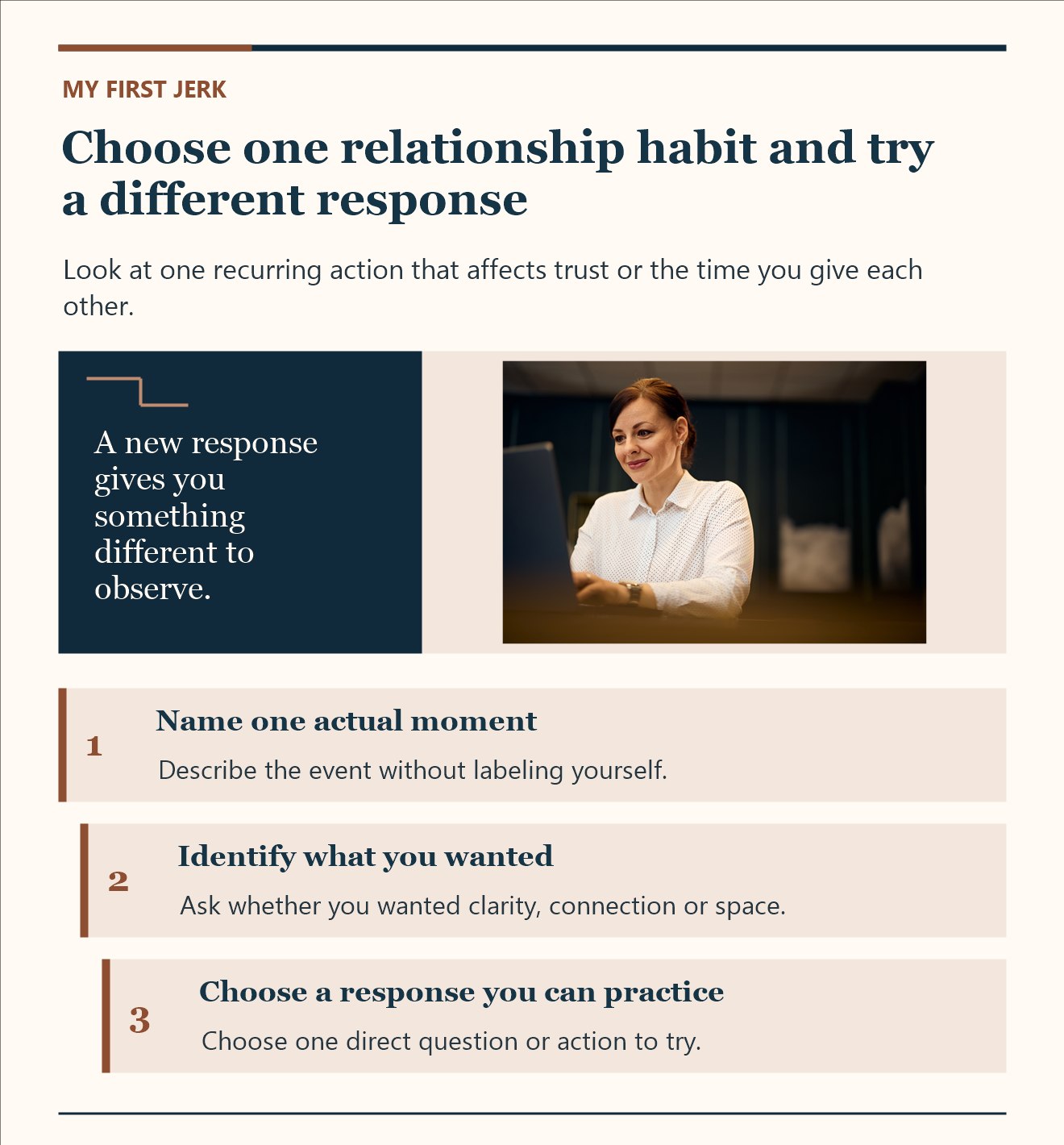
Choose one relationship habit and try a different response
If a late reply makes you send three messages asking whether someone is upset, first check whether a practical decision is waiting. One message such as “Are we still meeting tonight?” can help you get information without asking them to manage every worry.
Afterward, notice how both people respond. An ongoing pattern of pressure, intimidation or withholding may require other support alongside any change you make.
Read the infographic in text
Choose one relationship habit and try a different response
Look at one recurring action that affects trust or the time you give each other.
- Name one actual moment Describe the event without labeling yourself.
- Identify what you wanted Ask whether you wanted clarity, connection or space.
- Choose a response you can practice Choose one direct question or action to try.
A new response gives you something different to observe.