

Kindness can be warm and generous while still leaving room for your own preferences. People-pleasing is an everyday description for a pattern in which avoiding disapproval repeatedly pushes your needs out of the decision.
You do not have to become less caring. Start by noticing whether your yes is freely chosen, whether the offer fits your capacity and whether a respectful no is possible.
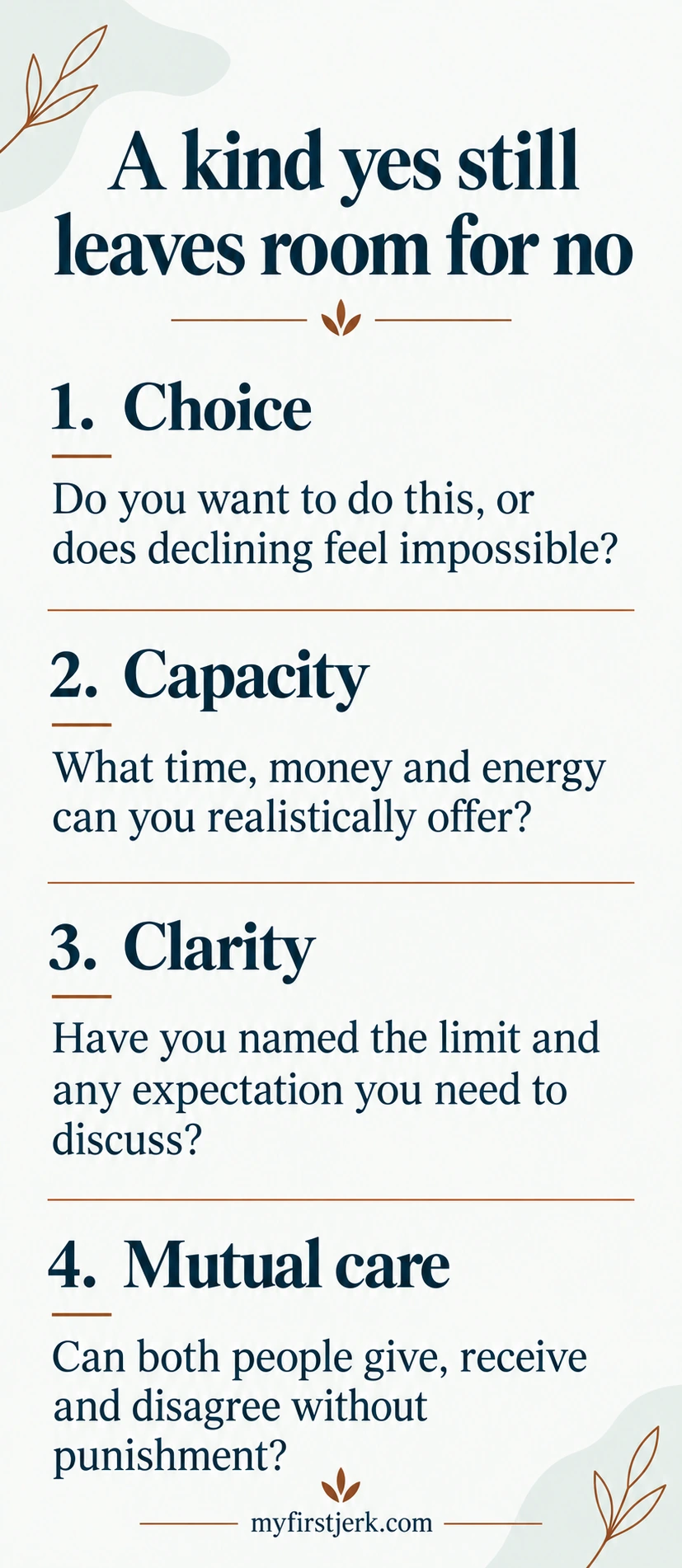
Before you agree, check four things
Read the guide as text
- Choice. Do you want to do this, or does declining feel impossible?
- Capacity. What time, money and energy can you realistically offer?
- Clarity. Have you named the limit and any expectation you need to discuss?
- Mutual care. Can both people give, receive and disagree without punishment?
Finding a Yes Answer
Before you agree, find out what is making you say yes. Is it something you want, and does it fit with what you can do? Are you choosing this even though you're being inconvenienced, or are you trying to prevent disapproval?
Feelings can be mixed. You might really want to help and also hope that the person appreciates what you do. This doesn't mean that what you do makes you a false person. The problem is when there are repeated patterns where fear makes your decisions and your own answers are unheard. You might not be able to feel that it's okay for you to decline a small request because this might make you feel unlovable.
Maybe you enjoy helping a date to prepare for a job interview. On another night, though, if you're not feeling well and you agree to hours of practice because saying no feels impossible, the same situation can have a different meaning depending on the choice and capacity you have.
Allowing Your Capacity to Choose
Capacity means what you're able to do. Kindness doesn't create more hours in your life, more money, or more energy. Find out what you can offer before you make a promise. Consider your priorities before making another commitment. In dating, that includes responsibilities, rest and the time you actually have.
You can ask yourself what'll happen if you don't say yes. The answer might mean that you'll have more time to rest, more time with your children, or more time for other commitments. Sometimes you might decide that the trade-off is worth it.
The goal is to be more aware than to try to figure out how much inconvenience you can handle. An effort that you choose on your own feels different from a pattern in which you're not allowed to ask for or say your feelings because it makes you feel like you're no longer a good person.
Wait Before You Answer
If you often agree before checking your availability, practise pausing before you answer. Say something like, "I'll check tomorrow and let you know." Use a real response time and then follow through.
You don't have to take a dramatic pause or explain your whole history when setting boundaries. This is just a regular way to consider an invitation, and you can decide yes or no without being dramatic.

For example, imagine Luis usually accepts dates immediately and then cancels existing plans with friends. He then starts checking his other commitments first, and sometimes he still says yes, or other times he offers a different day. The change doesn’t mean he’s unavailable, or he doesn’t find you desirable, but it is that he is allowing what is going on in his life to give an answer.
Have a Preference Plan
Being a people pleaser can make dating one-sided, even if the other person hasn't asked for that. If you say every option is welcome, they might not know if you have a preference. Say something like, "I would like to eat at a quieter place," or "I can meet on Saturday but not on Friday."
The Centre for Clinical Interventions provides resources for practising clear, respectful assertiveness. You can apply that principle without adopting a forceful personality.
A preference is information, not a demand, and the other person can talk about their own thoughts and look for a plan that works. Being easy to date doesn't mean you don't ever say what you really want.
Offering Open-Ended Help
If you have an open-ended offer, it can become more than you thought it should be. "I can help you move when you're ready," can be interpreted as you taking an entire weekend when you only meant to offer a couple of hours. Say what you actually want to offer, such as "I can help carry some boxes on Saturday until noon." If the person needs more, they can ask for more time.
You can decline some of the requests and accept other parts of it if that's what you want. You can say something like, "I can't lend you money, but I can help you put in applications for an hour."
You don't have to earn the right to say no by offering a different answer. Setting clear limits allows you to be kind while choosing what commitments you want to make, even if another person gets disappointed.
Be Honest About What You Expect in Return
Sometimes you might find yourself doing things for someone because you're hoping they'll recognize how much you care and give you something in return. Maybe you're always available when they need help, constantly making plans, or putting their needs before your own because you hope it will lead to more affection, commitment, or attention.
While there's nothing wrong with wanting those things, the other person might not realize what you're expecting. That's why it's important to be honest with yourself about why you're doing something. Ask yourself whether you'd still want to make the same effort if it didn't change how the other person felt about you.
For example, if you're constantly doing favors for someone because you hope they'll eventually want a serious relationship, you might be setting yourself up for disappointment. Instead of hoping they'll understand what you want through your actions, try having an honest conversation about where the relationship is going.
You don't have to feel bad for wanting love, affection, or commitment. But doing more for someone doesn't automatically mean they'll develop the same feelings. Both people need to be able to discuss what they want and freely decide whether they're looking for the same kind of relationship.
Allow Someone Else to Do Something Nice for You
If you're used to taking care of everyone else, it might feel strange when someone wants to do something for you. Maybe you're the person who always makes the plans, offers to help, or takes care of little details. When someone offers to return the favor, you might feel uncomfortable accepting it or immediately start thinking about how you can repay them.
But relationships shouldn't always involve one person doing everything. It's okay to let someone else make an effort, especially when it's something you genuinely appreciate. Sometimes simply saying, "Thank you, that would really help," is enough. You don't have to immediately return the favor or feel guilty for accepting someone's kindness.
For an illustrative example, imagine Ashley has been dating someone for a few weeks. When he offers to plan their next date and make reservations at a restaurant, they can both afford, she decides to let him handle it. Instead of worrying about how she can plan something even better in return, she simply appreciates that he's making an effort.
It's also important to remember that accepting a gift, dinner, or another kind gesture doesn't mean you owe someone anything. You don't have to agree to another date, share personal information, or become physically intimate just because someone spent money or did something nice for you.
The important thing is finding a healthy balance between giving and receiving. You can be thoughtful and generous without feeling responsible for everything, and you can appreciate someone's kindness without treating it like a debt you have to repay.
Allow for Disappointment
Someone might get disappointed that you can't meet them tonight, but that feeling doesn't mean you caused harm or that you have to change your answer. You can tell them you know they were hoping for the date to happen, but a different date works for you and then let them respond.
Don't just cancel your own needs because the moment feels uncomfortable. A relationship has to make room for different situations without making everyone responsible or trying to get rid of upset feelings.
There's a difference between being disappointed and retaliating. Threats, insults, and intimidation, or punishment for boundaries need serious attention. You don't have to tolerate any kind of harmful behavior in order to stop trying to please others.
Watch Out for Patterns
Look at ordinary interactions. Who makes the plans, travels, changes schedules, or follows through? This kind of understanding doesn't have to be the same. Work, disability, parenting, and other situations can affect what happens when it comes to dating. The question is whether both people are showing kindness and consideration and are willing to do what they can in their own capacity.
If you're doing most of the work, talk about a change, such as “I would like you to arrange our next date,” and then include a time or place you want to meet. Don't stop initiating dates just because the other person said no and you want them to pass this test. You can take time to pause if the current situation isn't working but be honest about what you want.
Having Empathy
You can understand why someone is stressed without thinking you're responsible for solving every problem they show you. Ask what kind of support they need and if you can offer it.
A date's financial difficulty, loneliness, or difficult history does not mean that you have to loan them money, give them housing, or always be available.
You can respond to a date’s loneliness by offering a conversation at a time you can manage, without promising to stay awake every night or become their only support.
Being Physical and Showing Kindness
You don't have to accept a kiss, sexual activity, or unwanted touch to not seem rude. Paying for dinner, sharing your feelings, or investing time doesn't mean that someone is allowed to have physical contact if you don't approve of it.
If you're not sure what you want, pause or tell them you're not ready for that. You don't have to give them an answer with a long explanation because the answer should be enough. A date who's caring will respect limits without making you responsible for their self-esteem or pressuring you.
This is important if you want to separate your kindness from an obligation. Your body isn't something you have to provide to someone to prove that you're considerate. Mutual choice should be part of healthy intimacy.
Know When You Need Support Before Speaking Up
Sometimes people get used to putting everyone else's needs before their own because speaking up hasn't always felt safe. Maybe you grew up in a home where disagreements led to arguments, or you've been in a relationship where expressing your feelings caused problems. If keeping others happy helped you avoid conflict in the past, it makes sense that speaking up might still feel uncomfortable.
But it's important to recognize that your needs matter, too. You don't have to criticize yourself for how you've handled difficult situations in the past. Instead, think about whether your circumstances have changed and whether you can begin making small decisions for yourself.
If someone you're dating threatens you, monitors your activities, tries to isolate you, or makes you afraid to disagree, getting private support from a domestic violence professional might be safer than confronting them. A counselor can also help if you've struggled with guilt, fear, or expressing your needs for a long time. You don't have to work through everything at once or practice setting boundaries with someone who makes you feel unsafe.
Start With One Small Change
If you're used to agreeing with everyone, learning to speak up can take practice. Instead of trying to change everything about how you communicate, start with one small situation where you feel comfortable expressing what you want.
For example, maybe a friend asks you to go somewhere, but you'd rather stay home. Instead of automatically saying yes, you could explain that you'd prefer to relax that evening. You might also practice suggesting a restaurant you enjoy or telling someone how much time you have available to help with something.
Afterward, think about how the conversation went. Were you clear about what you wanted? Did you give the other person an opportunity to respond? Were you able to stick with your decision without immediately changing your mind?
You might still feel nervous or guilty afterward, even when the other person responds positively. That's okay, and it doesn't mean you've done anything wrong. Sometimes it takes time to become comfortable expressing your preferences.
Remember that speaking up doesn't mean you have to start refusing every request or questioning everyone's intentions. The goal is simply to become more comfortable and being honest about what you want while still respecting other people's feelings and needs.
Correcting Answers with Reflection
You might see that after you agree, you can't manage a commitment you make. Tell the other person right away instead of hoping that the problem just disappears or that you carry it out resentfully.
You can say something like, “I agreed too quickly and cannot help for the whole evening. I can stay until six.” Acknowledge any inconvenience and apologise for changing an agreement when appropriate, without apologising for having limits.
The other person might need a different arrangement, and you can respect them in that way. Use this experience to make the next answer more understandable. Revising an overcommitment can be part of learning, but don't keep promising something that you can't do.
Staying Kind
Healthy kindness can be warm, generous, and flexible, but it also can be a no. You can ask for more notice or a financial limit and still be kind.
You can care about someone else's feelings but still see your own responsibilities and preferences. You can freely choose to make an effort without treating constant self-sacrifice as the price of being loved.
When you keep dating, look for a connection where both people can give and receive things, talk honestly, and make room for differences. No one has to perform constantly to show worth or affection.
The difference between being kind and being a people pleaser is clear when the choice is seen. A good yes is more meaningful when a respectful no is also possible. You can keep caring for someone while it becomes easier to know them and yourself.
Pause before saying yes
Choose a situation for a brief pause, a capacity check and wording you can adapt.
A kind response can include a limit or a no. A respectful sentence cannot guarantee that someone will accept your boundary.
Use the questions and examples in the article above; the draft builder needs JavaScript.
15 questions readers ask
1. Is people-pleasing a diagnosis?
Here it is an everyday description of a repeated pattern, rather than a diagnosis. A single generous act does not establish that pattern.
2. Can kindness involve inconvenience?
Yes. You may freely choose an effort because it matters to you. Notice whether the choice is voluntary and workable, rather than automatically driven by fear.
3. What can I ask before saying yes?
Ask whether you want to do it, what it will require and what you are giving up. Mixed feelings can be considered without judging yourself.
4. How can I pause before answering?
Say when you can give a response, then check your commitments. A simple pause is a normal part of considering an invitation.
5. Can I state a preference without demanding agreement?
Yes. “I can meet Saturday, but not Friday” gives useful information. The other person can share their availability so you can consider a workable plan.
6. How do I make an offer less open-ended?
Describe what you can do and for how long. Helping with boxes until noon is clearer than an unlimited offer to handle someone’s move.
7. Must I offer an alternative when I decline?
No. Offer one if you genuinely want to and can manage it. You do not have to earn the right to say no.
8. What if I am hoping favors will lead to commitment?
Wanting commitment is understandable, but favors cannot guarantee it. Discuss the relationship you want instead of relying on unspoken repayment.
9. Can I accept care without immediately repaying it?
Yes. You can appreciate a freely offered kindness. A gift or favor does not create an obligation to provide intimacy, private information or another date.
10. Does someone’s disappointment mean I hurt them?
Not necessarily. A person can be disappointed while still respecting your answer. That differs from threats, insults or punishment for a boundary.
11. How do I look at mutual effort?
Consider patterns in planning, travel, communication and follow-through. Contributions may differ with circumstances, while both people’s needs should remain visible.
12. Can I care without solving every problem?
Yes. Offer only the support you freely choose and can provide. A date’s difficult history or financial needs do not make you responsible for housing, loans or constant availability.
13. What if I already overcommitted?
Explain the change promptly, acknowledge its effect and offer only what you can actually do. Use the experience to make the next commitment more realistic.
14. Where can I start practising?
Choose a small, safe situation such as suggesting a restaurant or stating when you need to leave. The aim is honest participation, rather than refusing every request.
15. What if saying no feels unsafe?
Private specialist support may be safer than practising confrontation. You do not have to test boundaries with someone who threatens, monitors or intimidates you.