

Wanting to end a dating relationship can be painful when your partner wants to stay together. You may care about their feelings and still decide that you do not want to continue. Their agreement is not required for your decision to be real.
The useful question is how to communicate and make practical plans in your circumstances. A difficult conversation cannot guarantee a peaceful reaction. If you are unsure about leaving, consider your wishes first; if you have decided, focus on clarity, support and safety.
On this page
- 1. Consider safety before choosing the setting
- 2. Decide what you want to communicate
- 3. Be clear without predicting their response
- 4. Give yourself permission to end a repeated discussion
- 5. Keep practical arrangements separate
- 6. Set a contact boundary you can use
- 7. Let support continue after the conversation
- 8. Separate respect from an obligation to stay friendly

1. Consider safety before choosing the setting
Think about how your partner has responded to boundaries before. Threats, monitoring, coercion or fear of retaliation call for different planning from an ordinary disagreement. Seek private support from an appropriate local service if you are worried about your safety.
Love is respect’s breakup guidance makes clear that an in-person conversation is not required when it would be unsafe. Depending on your situation, remote communication or support nearby may be a better option. You do not need to meet privately to prove that you are being considerate.
2. Decide what you want to communicate
Prepare a short statement that reflects your actual choice. For example: “I have decided to end our relationship. I know that is painful to hear, but I am not asking for a break or planning to try again.” Use only the parts that are true for you.
You may want to give a brief reason, such as wanting a different kind of relationship or no longer wanting to date. You do not need to list every fault or provide an explanation that the other person finds persuasive.
If you are still deciding, considering the relationship you actually have can help you separate that question from the pressure of the conversation.
3. Be clear without predicting their response
Your partner might be sad, surprised, angry or ready to accept the decision. You cannot know exactly what they will feel, and you do not need to describe them as manipulative simply because they are disappointed.
Listen if you want to and it is safe, but distinguish hearing their feelings from reopening the decision. You can say, “I understand that you want another chance. My decision is still to end the relationship.” Avoid promising a future meeting or friendship just to soften the moment.
4. Give yourself permission to end a repeated discussion
If the conversation keeps returning to the same request, you can stop. “I have explained my decision, and I am ending this conversation now” is enough where it is safe to say so. You do not have to find a perfect final sentence that produces acceptance.
Feeling upset or crying does not invalidate your choice. You can pause or leave rather than treating calmness as a performance you must maintain. If a conversation becomes threatening, prioritise getting appropriate help and distance.
5. Keep practical arrangements separate
Shared belongings, a home, finances, work or caring responsibilities may require further arrangements. Identify which matters need attention and use suitable professional or local support when they are complicated. A general breakup script cannot settle those obligations.
Where contact is necessary, keep it focused on the particular task. You can discuss returning a key without agreeing to another conversation about whether you should stay together.
6. Set a contact boundary you can use
You might choose no personal contact, a limited written channel for practical matters or another arrangement that fits your circumstances. Be specific about what you are agreeing to, and avoid accepting an arrangement only because you feel guilty.
Ask trusted friends not to pass along messages or share your location without permission. If contact becomes threatening or persistent, seek suitable local support. Save concerning messages where it is safe to do so, rather than repeatedly engaging to demand an explanation.
7. Let support continue after the conversation
Ending a relationship does not mean that you will immediately feel relieved. You may miss your partner or question parts of the decision. Those feelings do not automatically mean that you should resume contact.
Plan ordinary support: someone you can talk to, a place you can spend time or help with a practical task. If you are concerned about retaliation, continue safety planning after the breakup rather than assuming the risk ended with the conversation.
8. Separate respect from an obligation to stay friendly
You can avoid cruelty while deciding against friendship, another meeting or further explanations. You do not have to protect your ex’s reputation by keeping serious concerns from people whose support you need.
Your role is to communicate as clearly and safely as you can, not to make the other person feel happy about the decision. A breakup can remain painful while you take practical steps toward the life and relationships you want.
Plan the breakup and the next practical task separately
If you have decided to end the relationship and need to return a borrowed item, state your decision clearly and discuss the exchange as a separate plan. If you are worried about threats or monitoring, consider private advice before sending a message or meeting.
When you share a home, money or a care responsibility, seek qualified local advice where needed. You can make the immediate choice about contact while you arrange help with the next steps.
Read the infographic in text
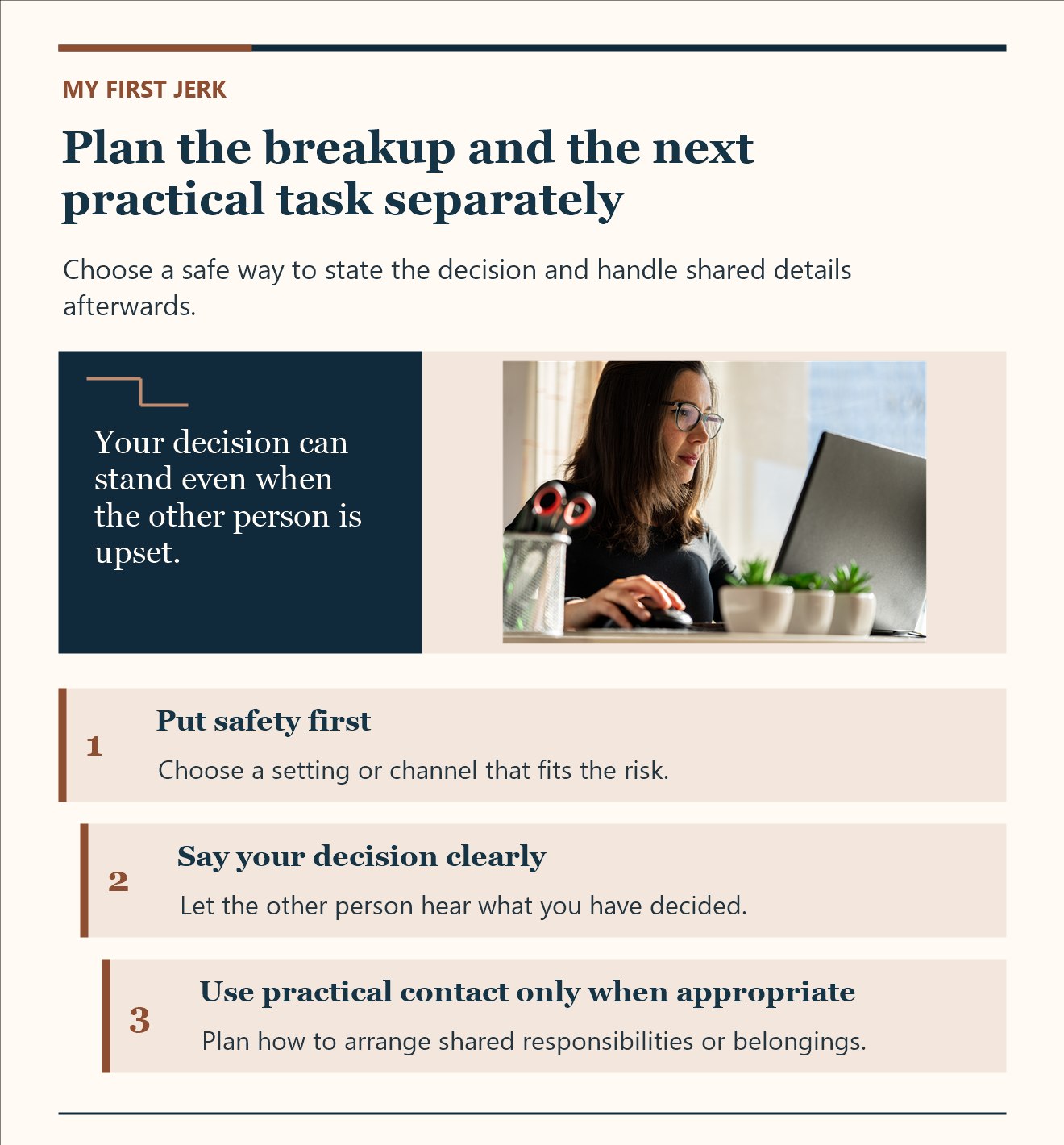
Plan the breakup and the next practical task separately
Choose a safe way to state the decision and handle shared details afterwards.
- Put safety first Choose a setting or channel that fits the risk.
- Say your decision clearly Let the other person hear what you have decided.
- Use practical contact only when appropriate Plan how to arrange shared responsibilities or belongings.
Your decision can stand even when the other person is upset.