

You can feel strongly about someone who is not available to date you. They may have declined, be committed elsewhere or want a different kind of relationship. The feeling can be real even when the relationship you hope for is not on offer.
You do not need to diagnose yourself as afraid of commitment or lacking self-respect. Start with what you know, what the other person has freely agreed to and how the situation affects your life. These five steps can help you consider a workable next move.
On this page

1. Separate the hope from the available relationship
Write down what has actually been said or agreed. Then, separately, note what you wish might happen. “We chat at work” and “We have agreed to date” describe different situations. Warmth, chemistry or an occasional message cannot fill in that difference.
If someone has clearly declined, you do not need another conversation to test whether the answer will change. If the situation is genuinely unclear and asking is appropriate, one straightforward invitation can give them room to answer. Treat a refusal, a request for distance or repeated avoidance as a reason to step back.
A person being married or having another partner is not proof that they are especially desirable. Existing commitments and any relationship agreements matter. Avoid making your plans depend on promises about a separation that has not happened.
2. Reduce the contact that keeps you waiting
Notice which habits leave you preoccupied: rereading messages, checking updates or keeping every evening free in case they call. Choose a small boundary that helps you regain your attention, such as muting an account or making plans without checking their availability first.
When you share a workplace, friendship group or responsibility, complete avoidance may not be practical. You can keep necessary exchanges courteous and brief, avoid private flirtation and decline conversations that repeatedly reopen the same hope.
Distance is for your own space. It should not be a test designed to make the person jealous or persuade them to pursue you.
3. Let disappointment exist without bargaining
You may feel sad, embarrassed or frustrated. Those feelings do not mean you have failed, and you do not have to stop caring before respecting a boundary. Avoid trying to prove that your good qualities earn you a different answer.
When love is not returned, caring for yourself while respecting their answer can be more useful than searching for a hidden sign. Talk to someone who can listen without encouraging you to keep pursuing a person who has said no.
4. Consider the kind of connection you want
Ask what you would like in an actual relationship: mutual interest, time together, openness about plans or a particular commitment. Compare those wishes with what is available now. Attraction alone cannot settle a difference in goals.
You do not owe a date to a friend simply because they are available. You also do not have to start dating immediately. If you do want to meet people, choose settings you enjoy and look for interest that is freely returned, rather than someone to use as a distraction.
5. Choose one step that gives your own life room
Your next step might be ending a private flirtation, taking a break from updates or returning to plans you have postponed. Keep it specific enough to do without needing the other person to cooperate.
If this situation keeps recurring, reflect with curiosity: what did you know at the beginning, what made you stay hopeful and which limits were hard to keep? A suitable counsellor may help you explore that pattern if you want support. A repeated experience is a reason to look more closely, not a verdict about your character.
You can acknowledge what you hoped for and still decide that waiting is no longer right for you. No new relationship or happy ending needs to be guaranteed for that decision to be worthwhile.
Read the infographic in text
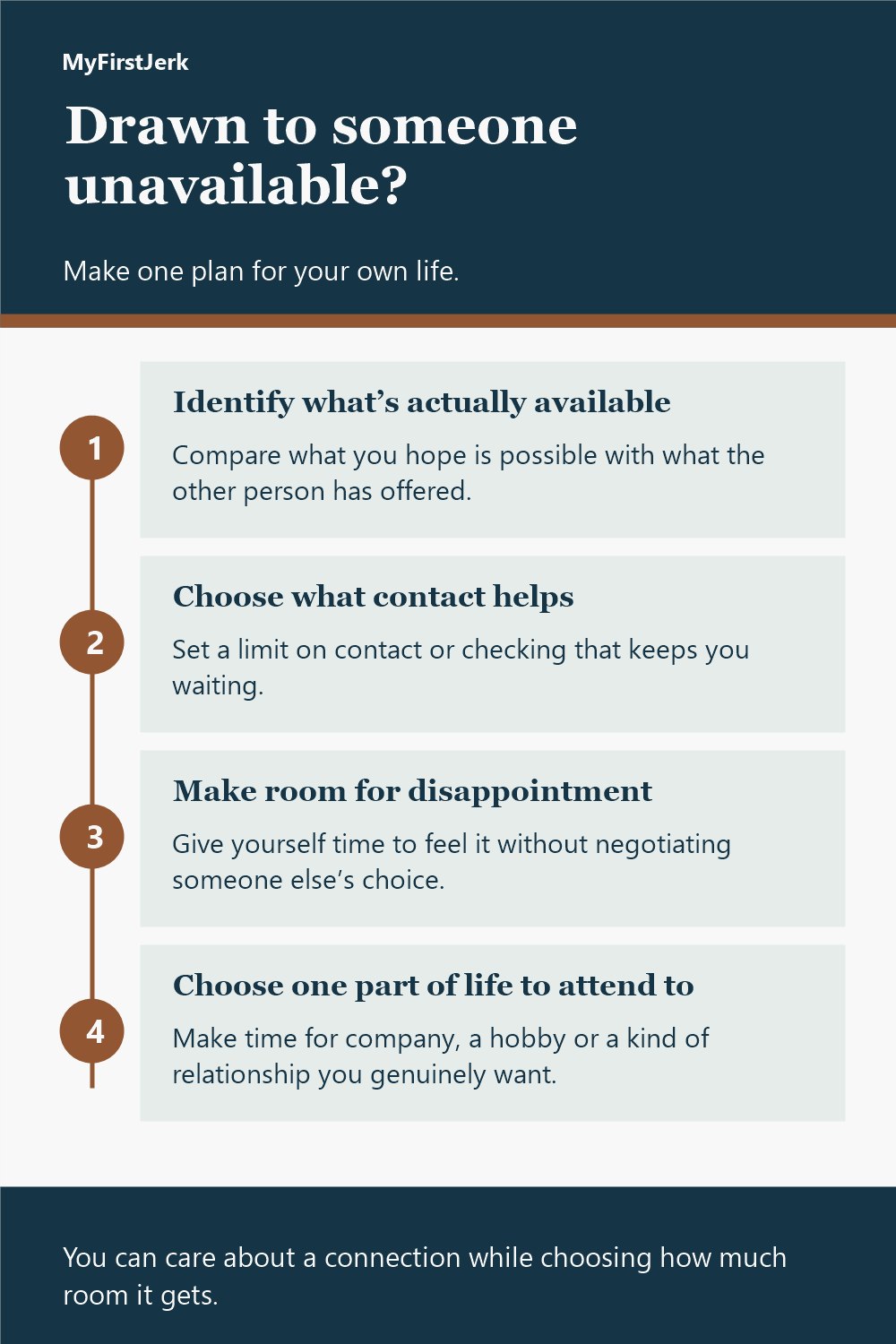
Drawn to someone unavailable? Make one plan for your own life.
- Identify what’s actually available Compare what you hope is possible with what the other person has offered.
- Choose what contact helps Set a limit on contact or checking that keeps you waiting.
- Make room for disappointment Give yourself time to feel it without negotiating someone else’s choice.
- Choose one part of life to attend to Make time for company, a hobby or a kind of relationship you genuinely want.
You can care about a connection while choosing how much room it gets.