

Wanting reassurance or regular contact does not make you a problem. Difficulties can arise when the wish for closeness turns into repeated checking, pressure or contact that the other person has not agreed to. Focus on the specific action rather than calling yourself or your partner clingy.
These ten ideas offer ways to ask for connection while keeping room for both people’s choices. You can also consider whether the relationship offers the kind of contact you want.
On this page
- Name what you want from reassurance
- Make one clear request
- Discuss contact that fits ordinary life
- Pause before sending another message
- Respect time apart without using it as a test
- Keep privacy in the relationship
- Attend plans by invitation and agreement
- Step back from interpreting social-media clues
- Keep room for interests and other support
- Consider whether the relationship fits your needs

1. Name what you want from reassurance
Ask what would help you feel clearer: knowing when you will next meet, hearing an answer to a question or understanding what the relationship means to both people. A specific need is easier to discuss than a demand to make every uncertainty disappear.
You may want several things. Choose the most useful starting point instead of asking the other person to solve them all at once.
2. Make one clear request
You might say, “I enjoy hearing from you between dates. What kind of contact would work for you?” Give the person room to answer honestly, including an answer that differs from what you hoped.
A request leaves room for choice. Repeating it until someone agrees, or treating a refusal as proof they do not care, can turn the conversation into pressure.
3. Discuss contact that fits ordinary life
Talk about work, rest, responsibilities and time away from a phone. Consider whether you want to make plans in advance or let each other know when a plan changes. There is no universal number of messages that proves a relationship is healthy.
You can ask for more contact while also hearing that a particular arrangement is not possible for the other person.
4. Pause before sending another message
Notice what an additional message would do. If a practical plan needs an answer, ask that question briefly. If you are hoping repeated messages will settle uncertainty about the relationship, a later conversation may be more useful.
A slow reply does not establish what someone feels. Consider your next ordinary activity rather than making the phone the only thing you are waiting for.
5. Respect time apart without using it as a test
A partner may want time with friends, relatives or no company at all. You can have feelings about that while respecting the choice. Time apart does not have to be a tactic to make someone miss you.
If the amount of time together is unsatisfying, discuss the arrangement directly instead of trying to work out whether a certain length of absence proves love.
6. Keep privacy in the relationship
Ask questions with interest, without demanding passwords, private messages or a detailed account of every movement. Shared plans may require practical information; that does not make all personal information available on demand.
Both people can choose what to share. If you feel unable to accept an answer, reflect on the agreement and your next choice rather than escalating the checking.
7. Attend plans by invitation and agreement
Ask whether a gathering is a shared plan before assuming you are included. Respect a declined invitation or a plan someone wants to attend alone. You can also decline an invitation yourself.
Do not arrange repeated uninvited appearances to gain reassurance. Make a direct request for time together and consider the answer you receive.
8. Step back from interpreting social-media clues
Likes, views and posts cannot reliably establish someone’s private feelings. If repeatedly checking them leaves you more unsettled, consider putting the app aside or changing how often you use it.
Ask about a specific concern when it affects an actual agreement. Avoid contacting other people for updates or trying to provoke a response through your own posts.
9. Keep room for interests and other support
Make time for people, responsibilities and activities that matter to you. Choose what is accessible and welcome, rather than treating independence as another performance you must get right.
Our guide to making room for yourself while dating offers small, affordable options. Support outside a relationship can coexist with wanting closeness inside it.
10. Consider whether the relationship fits your needs
After talking, notice what contact and care are actually available. You do not have to become comfortable with an arrangement that repeatedly leaves you dissatisfied. The other person does not have to promise something they do not want to offer.
You can seek support, ask for a different arrangement or choose to leave. Respecting someone’s space includes taking responsibility for your own decisions about the relationship.
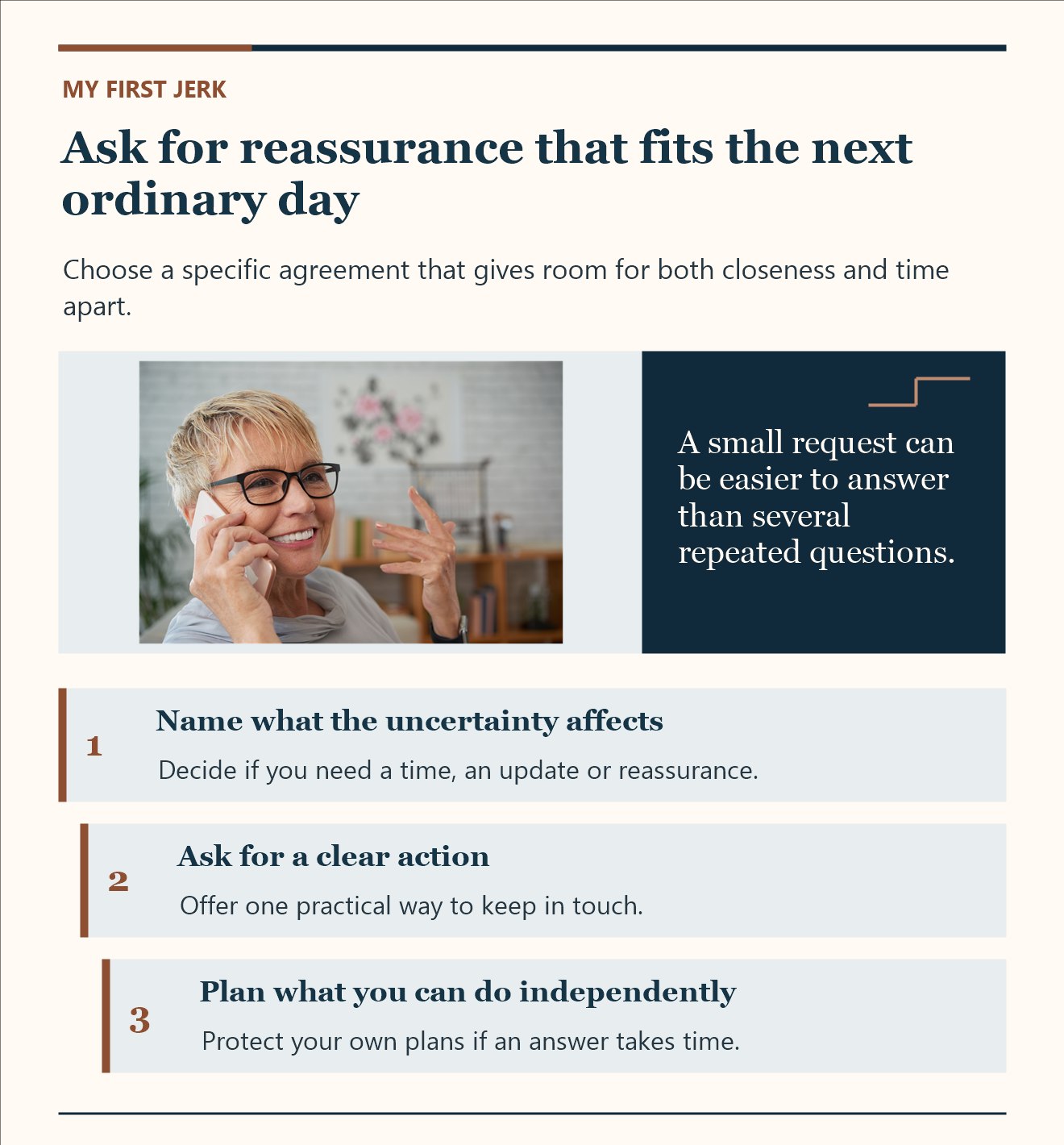
Ask for reassurance that fits the next ordinary day
If you want to know whether you will talk after a long shift, you might ask to exchange goodnight messages or agree on a short call the next day. Ask what the other person can genuinely keep and give them room to suggest something else.
Choose something you can do during the time apart. If the arrangement regularly leaves you distressed, talk about whether it needs to change or whether other support would help.
Read the infographic in text
Ask for reassurance that fits the next ordinary day
Choose a specific agreement that gives room for both closeness and time apart.
- Name what the uncertainty affects Decide if you need a time, an update or reassurance.
- Ask for a clear action Offer one practical way to keep in touch.
- Plan what you can do independently Protect your own plans if an answer takes time.
A small request can be easier to answer than several repeated questions.