

When a partner becomes less responsive, you may wonder whether something has changed between you. Fewer messages, cancelled plans or less conversation can leave you uncertain. They do not, by themselves, explain his feelings or tell you what will happen next.
You do not need to change your appearance, hide your wishes or become more available to earn an answer. Focus on what you have noticed, what you want to ask and whether the relationship on offer works for you.
On this page

1. Describe the change you can observe
Separate events from explanations. “We have not made a plan for three weeks” is something you can discuss. “He is trying to make me chase him” is a possible interpretation, not something silence establishes.
Consider the arrangement you already had. A change from daily conversation may feel different from a new connection where you never agreed how often to stay in touch. Neither situation makes your wishes unreasonable, but the conversation may start in a different place.
Choose one or two examples rather than compiling every delayed reply. If you are wondering whether he is losing interest, seek clarity without treating behaviour as a mind-reading test.
2. Ask directly without demanding a particular answer
Where speaking is safe and welcome, try a clear question: “I have noticed that we are making fewer plans. Do you still want to continue dating, and what kind of contact feels workable?” The wording is an example you can adapt, not a script that guarantees honesty.
Leave room for an answer you may not want. He might describe a practical difficulty, ask for a different arrangement or say that he does not want to continue. You can listen without automatically agreeing to wait or reducing your needs.
If he has already ended the relationship or asked for no contact, respect that boundary. Another conversation is not required before you can begin making your own plans.
3. Distinguish space from an indefinite wait
A request for space can be discussed concretely if both people want to stay connected. Ask what it means for practical matters and whether there is an agreed time to check in. You do not need to request constant updates during the pause.
At the same time, you can decide that an open-ended arrangement does not suit you. “I respect that you need space, but I do not want to keep planning around a relationship with no agreed next step” describes your position without demanding that he feel differently.
4. Keep your own needs in the conversation
Wanting dependable plans or some regular conversation is not a character flaw. Ask yourself what contact you would choose if you were not trying to prevent him from leaving. Then consider whether both of you want an arrangement that can include those needs.
A period of stress may explain someone having less time. It does not settle every question about compatibility, nor does it require you to accept dismissive treatment. You can care about his circumstances and still consider whether the relationship works for you.
5. Observe follow-through without testing him
If you agree on a plan, look at whether it happens and whether changes are communicated. One warm conversation cannot answer every concern, and one late message does not prove that the relationship is over.
Avoid creating jealousy, withholding replies as punishment or using sex or a new appearance to test his interest. Keep friends, activities and rest in your life because they matter to you. Independence should not become a performance intended to make someone miss you.
6. Choose a next step you can carry out
You might agree to a specific plan, stop holding time open or end an arrangement that remains unclear. Explain a decision plainly where doing so is safe. You do not need a confession about his motives before deciding what you want to participate in.
If attempts to talk lead to threats, humiliation, monitoring or fear, seek private support from an appropriate local service. Addressing emotional distance should not require putting your safety at risk.
A clearer conversation may improve an arrangement or reveal that you want different things. Either way, your next step can reflect the relationship available now, without a promise that he will return or that another partner is waiting.
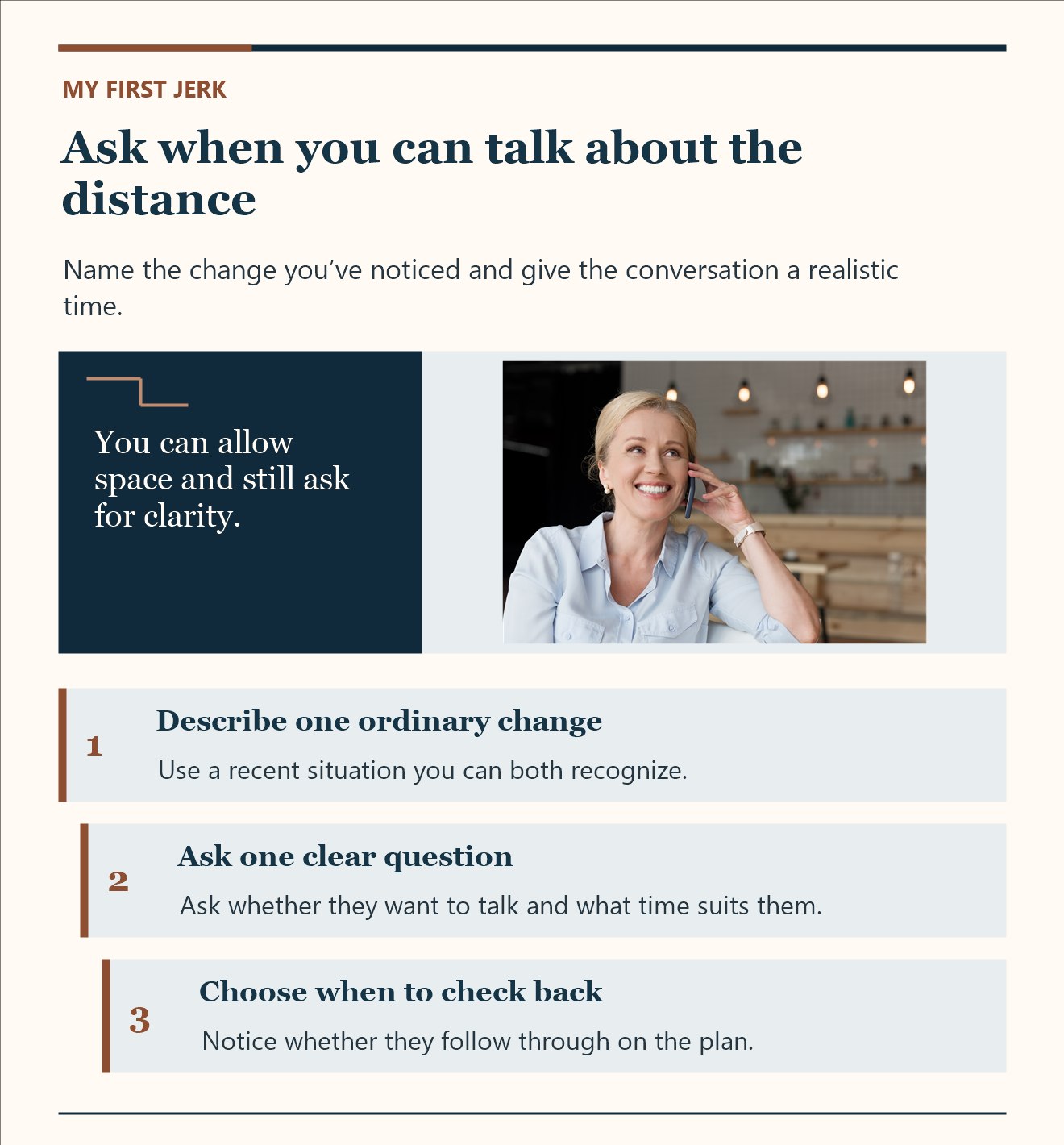
Ask when you can talk about the distance
If your partner usually calls while walking home and has stopped doing that, say what you miss and ask whether there’s a better way to talk. Give them room to name a change in work, care or feelings without assuming the cause.
If they ask for some space, talk about when you will check back if it is appropriate. You can decide how much uncertainty suits you based on what happens afterwards.
Read the infographic in text
Ask when you can talk about the distance
Name the change you’ve noticed and give the conversation a realistic time.
- Describe one ordinary change Use a recent situation you can both recognize.
- Ask one clear question Ask whether they want to talk and what time suits them.
- Choose when to check back Notice whether they follow through on the plan.
You can allow space and still ask for clarity.