

When someone asks for forgiveness, they may also be asking to return to your life. You are allowed to consider those requests separately. You can hear an apology without restarting a relationship, and you can decide what contact you want before deciding what forgiveness means to you.
There is no need to prove that you are generous, spiritually ready or free of hurt before setting a boundary. Start with the action that affected you and the choices available now.
On this page

Separate forgiveness, trust and contact
People use forgiveness in different ways. For some, it means letting go of a wish for revenge. For others, it is a personal or spiritual process. You do not have to accept another person’s definition or use the word before you are ready.
Trust concerns what you are willing to rely on. Contact concerns whether and how you communicate. Neither follows automatically from forgiveness. For example, you might no longer want an argument but still choose not to share private information with that person.
If spiritual beliefs help you understand the experience, they can coexist with practical boundaries. A belief in compassion does not require you to accept further harm.
Look at responsibility rather than a promised transformation
An apology can acknowledge a specific action, its effect and a proposed change. It does not prove that change has happened. Consider whether the person can take responsibility without blaming your reaction or demanding that you stop discussing the issue.
Where both people want to continue, considering willingness and accountability together may be more useful than deciding whether the person is entirely good or bad. You can recognise a caring quality while taking a harmful action seriously.
You do not owe someone access to you so they can demonstrate that they have changed. They can take responsibility for their behaviour even if you decide against renewed contact.
Choose boundaries that fit the actual situation
Think about what you are protecting: your time, privacy, belongings, emotional space or physical safety. A boundary can be specific, such as declining late-night calls or discussing a shared practical matter only in writing.
If you share responsibilities, complete separation may not be immediately possible. Keep necessary exchanges focused and consider suitable support for arrangements you find difficult. Avoid promising closeness simply to make a practical conversation easier.
When there are threats, coercion, stalking or fear of retaliation, seek private support from an appropriate local service before announcing plans or arranging a meeting. Another chance is not a required step toward being fair.
Keep support available while you decide
You may want to talk with someone who can help you sort out what happened without deciding for you. Ask for the kind of support you need: listening, practical help or a different perspective on a repeated pattern.
Choose someone who respects privacy and will not contact the other person on your behalf without permission. You can also ask for fewer questions while you think. Taking time is different from agreeing to an indefinite wait for someone else’s promised change.
Support does not have to be conditional on choosing reconciliation. You can seek help while feeling uncertain, angry or still attached.
Revisit your choice when circumstances change
You might decline contact, agree to a limited conversation or explore whether a relationship is still wanted. Make only the agreement you actually intend. A conversation does not have to imply that everything is restored.
If you choose renewed contact, consider how you will notice whether agreements are being kept. You can raise a concern again or change your mind if the arrangement no longer works for you.
Your own past mistakes do not create a debt to give every other person another chance. Compassion can include caring about someone while deciding that the relationship should not continue.
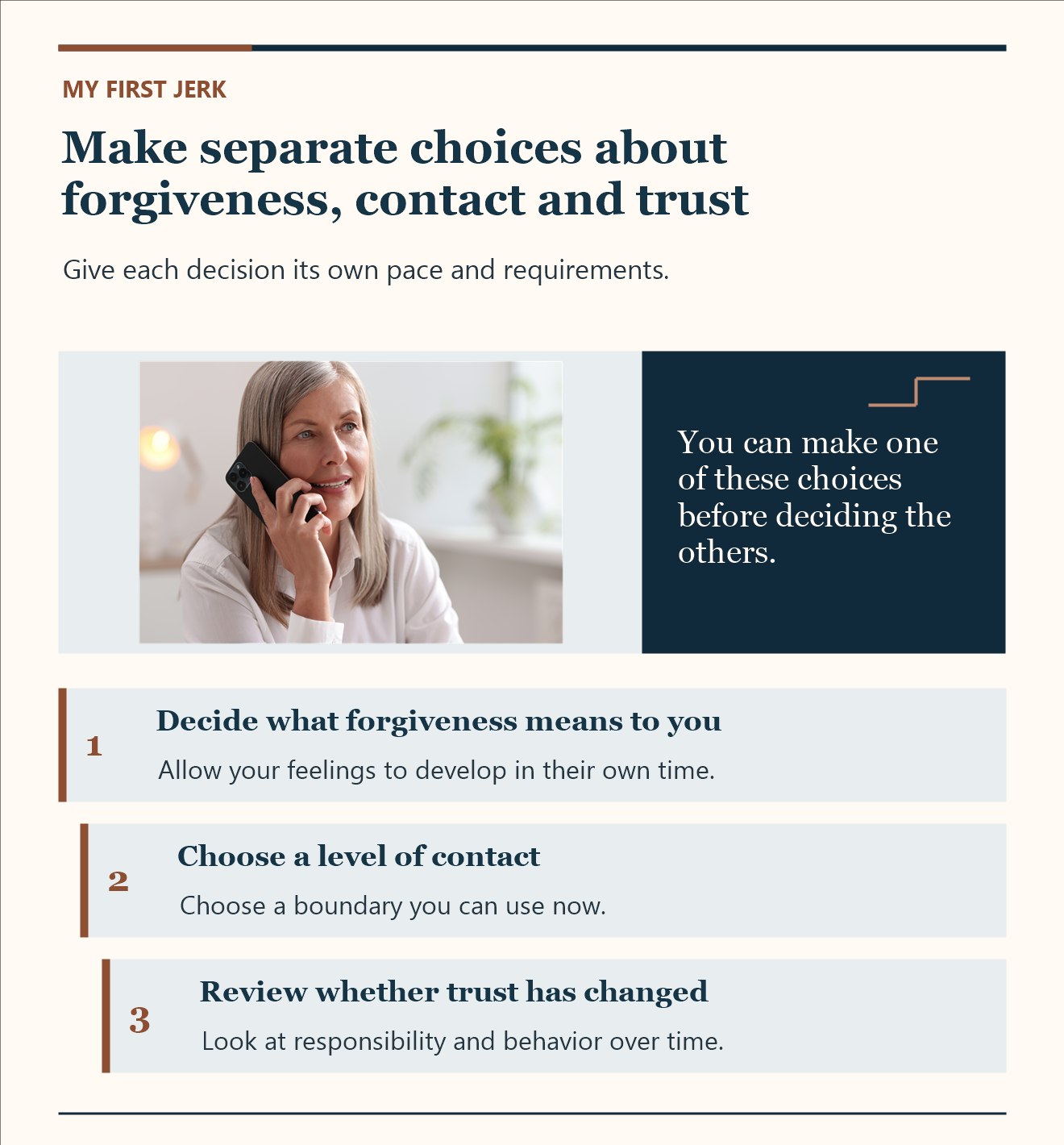
Make separate choices about forgiveness, contact and trust
If someone apologizes for sharing something private, you can accept the apology and keep future conversations on ordinary topics. You can also choose not to reply immediately. Notice whether the person protects your confidence over time before sharing something personal again.
If the person pressures you to prove you have forgiven them, return to what you need rather than making a promise. You can revisit your limits without owing anyone a timetable.
Read the infographic in text
Make separate choices about forgiveness, contact and trust
Give each decision its own pace and requirements.
- Decide what forgiveness means to you Allow your feelings to develop in their own time.
- Choose a level of contact Choose a boundary you can use now.
- Review whether trust has changed Look at responsibility and behavior over time.
You can make one of these choices before deciding the others.